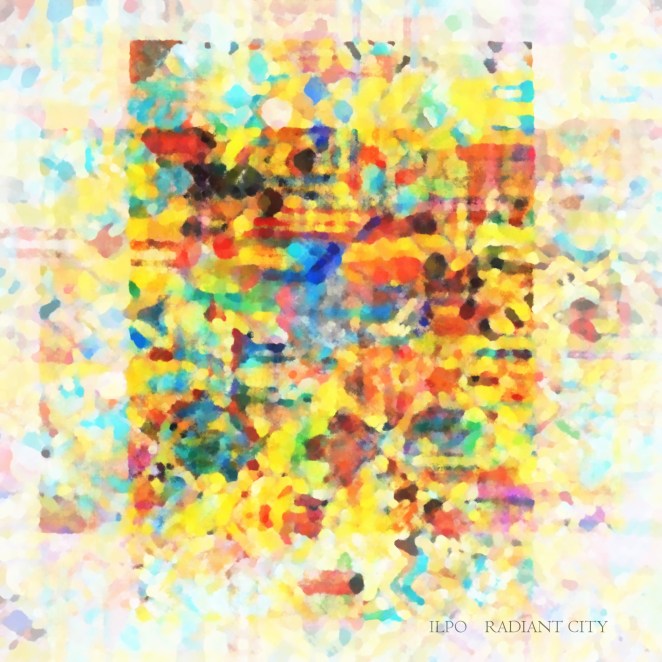
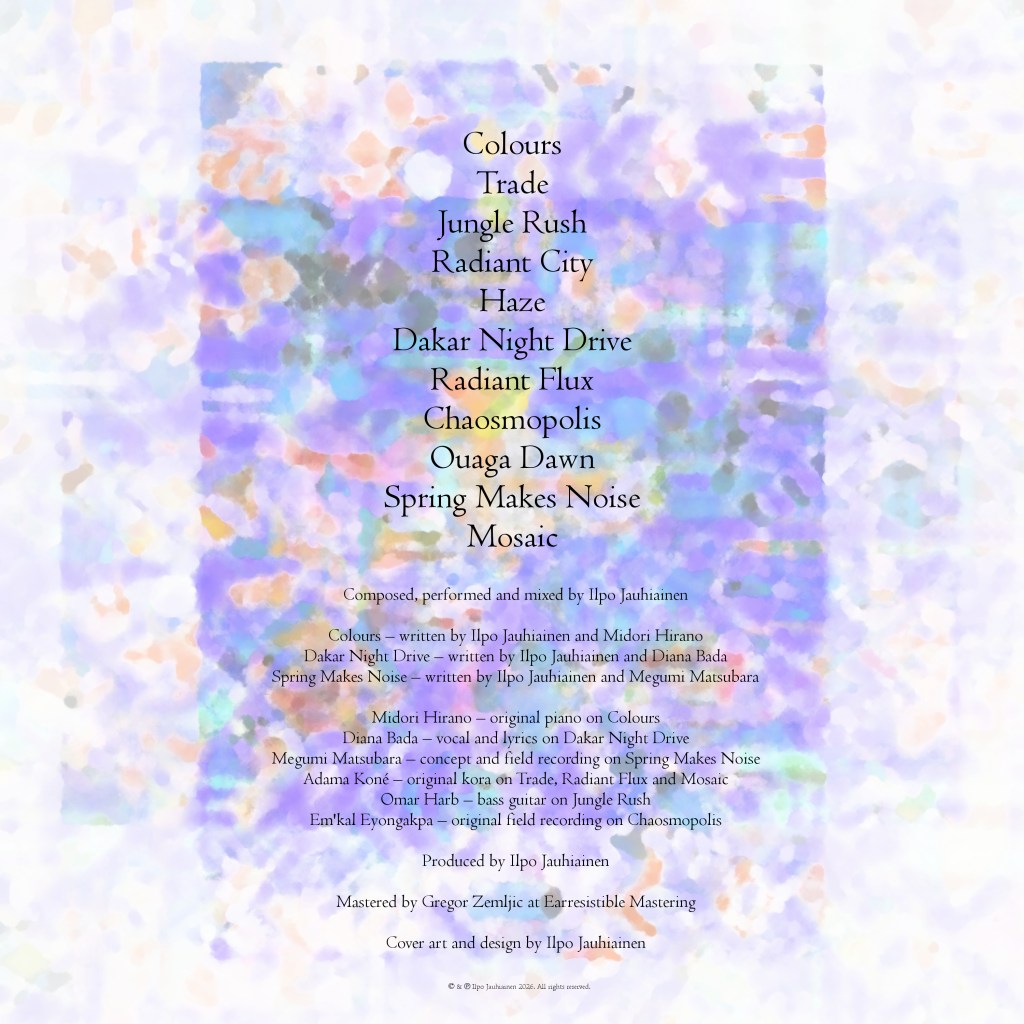
My new album Radiant City is now available on all the streaming platforms worldwide, including the unethical Spotify as well as the highly ethical Bandcamp, where the release comes with an extended album artwork and higher quality download (the Bandcamp release is always the official one: it’s the only platform treating artists fairly!).
The album is inspired by an idea of the city: a dynamic, hybrid, inclusive and thriving multiplicity—not Le Corbusier’s vision of a linear and ordered metropolis of the future, but rather an indeterminate and colourful incubator of our present (and near future). It is my 14th album exploring the contiguities and textures between electronic music and various geographies around the world.
Featuring contributions from Midori Hirano, Diana Bada, Megumi Matsubara, Adama Koné, Omar Harb, Viktoriia Vitrenko and Em’kal Eyongakpa, the album contains works spanning 21 years—ever since the first Spring day of 2005, when artist-architect Megumi Matsubara and I decided to take a break from our recording session and go for a walk around my then neighbourhood of Dalston, London, recording the urban soundscape as we strolled and chatted along. Back in the studio we had an idea to turn our walk into a “pop song” by editing the captured Dalston-Stoke Newington soundscape onto an existing backing track of mine, and what was serendipitously finished in an hour during that inspired and radiant early evening, is finally published here in its original form.
It was also then that I got the idea for this album, but I had to walk around a few other cities and neighbourhoods before the album was ready.
This will probably be my last album release in the traditional sense. Releasing novel albums no longer generates the same philosophical and cultural discussions as it did in the 70s, 80s and 90s—the upbringing that made me want to work in the field music in the first place (instead of sciences or literature)—and I feel I’m wasting my skills working in this over-saturated, decaying domain. It’s been an exhilarating trajectory of 30 years of exploring the boundaries of music, of trying to produce the most exciting and timely music of the moment and generate new cultural discussion—the latter always to no avail, of course.
From now on, I want to work on something where there is no industry for; something that nobody has a name for; where there are no capitalists and profiteers defining what the system, criterion or philosophy—the world—is. This is what I call ‘world-expression’: the potential of the whole world without the narrowing effect of capitalism or any other such belief system.
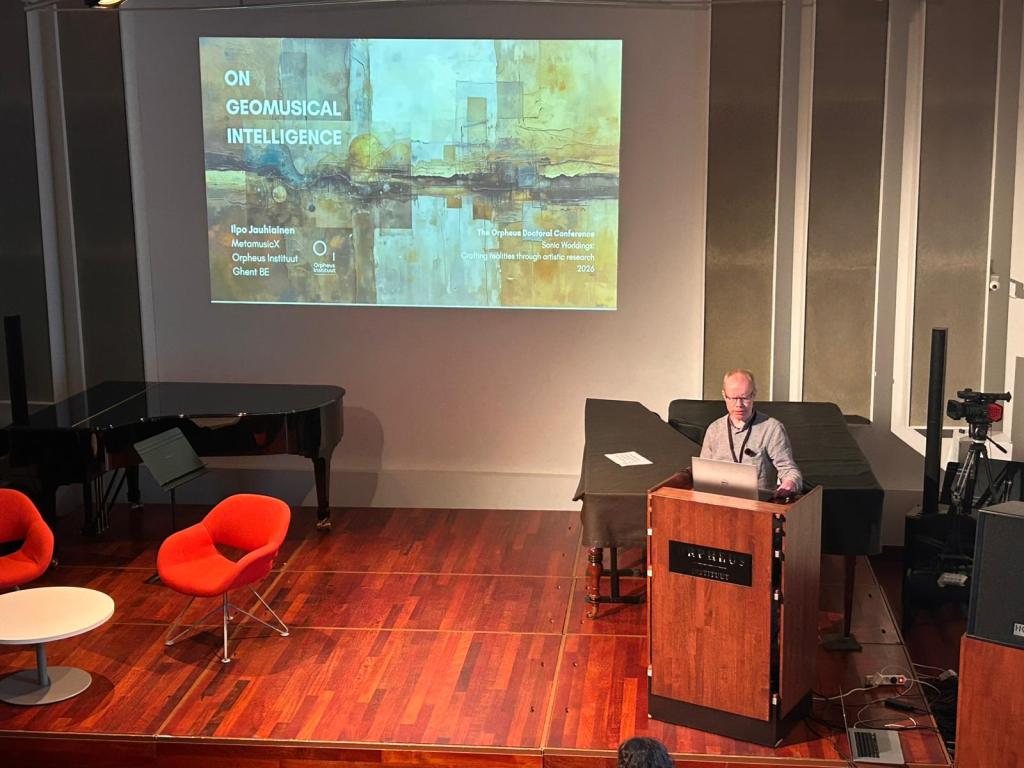
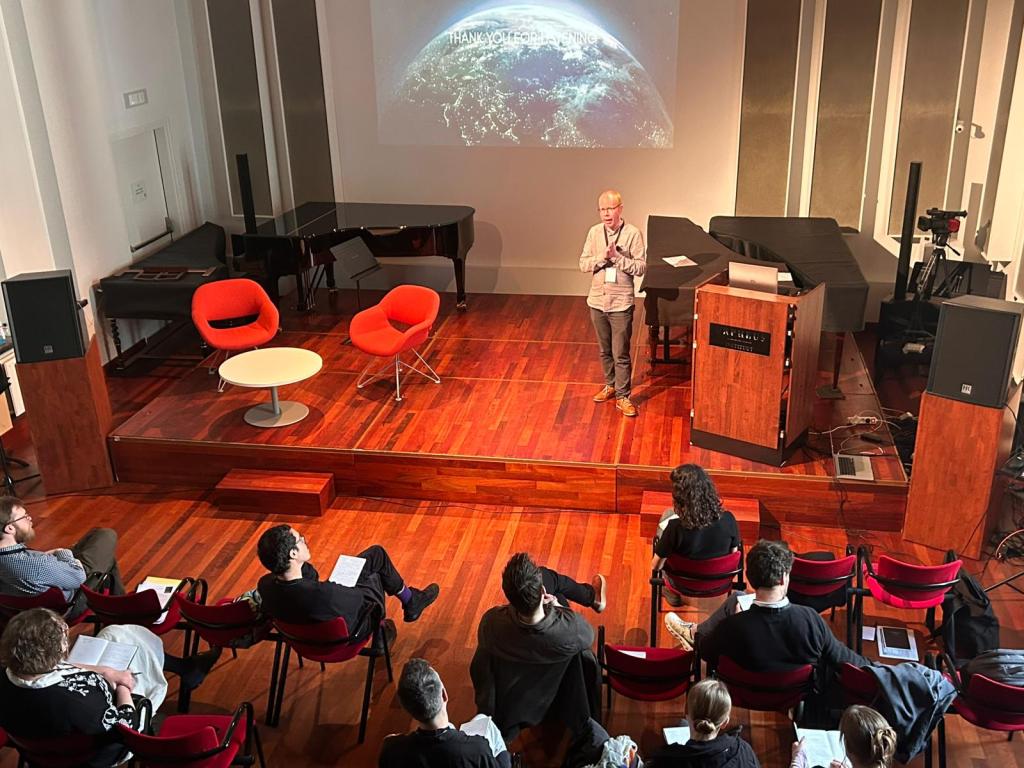
On that note, it was a great privilege and delight to both organise and present at the 2026 Orpheus Doctoral Conference, Sonic Worldings: Crafting realities through artistic research, at Orpheus Instituut, Ghent.
Thank you again to our wonderful presenters, keynote speakers, participants and organisers for creating such an inspiring and colourful experience! As I said in my closing remarks, I rarely experience conferences where every presentation fills me with curiosity, inspiration and excitement – at ODC 2026 we achieved that, I believe: at least I always found my attention drifting back to whatever was happening on the stage, always returning to our key research questions. 🙂
We’ll be (quite likely) publishing the proceedings of the conference in near future, with all the presentations transcribed and revised for a stimulating and novel publication. Watch this space!
We craft and world our reality through attention and care. In the universe where nothing matters (to refer to the film ‘Everything Everywhere All at Once’, examined in one of our presentations), it is precisely our act of attention and care that becomes even more powerful – we choose to care and direct our attention in the universe with no meaning, will or consciousness. How powerful is that?

